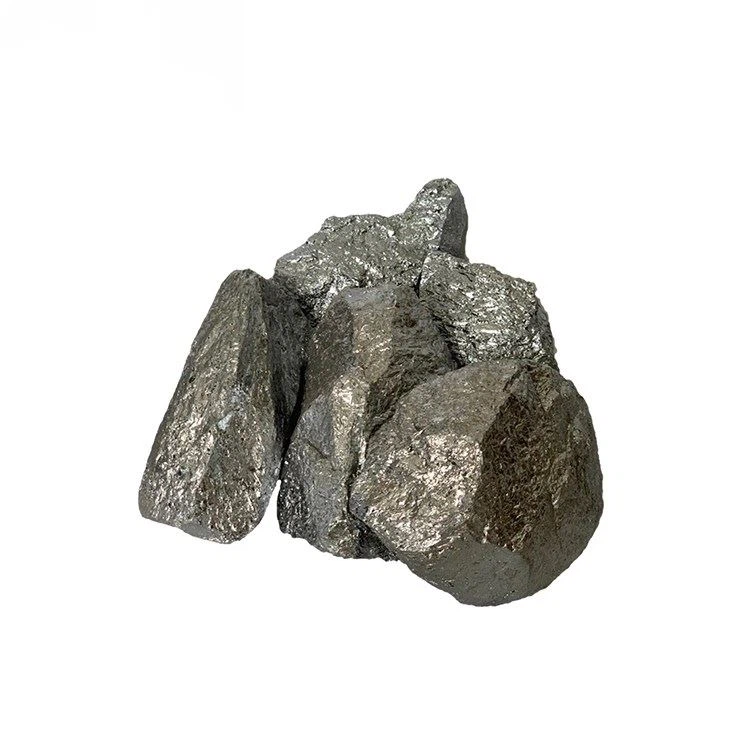
A: Silicon metal (symbol Si), in its pure form, is a grey metallically lustrous metalloid element. Metallurgical grade silicon is known as silicon metal because of its lustrous appearance. The main uses of silicon metal are in the aluminium and chemical industries (BRGM, 2021). In addition, silicon metal is a strategic raw material used in the renewable energy (photovoltaic industry), in electronic devices, and-with a growing demand in batteries. Silicon metal is listed on the EU critical and strategic raw materials lists 2023.
A: Silicon is one of the most useful elements to mankind. Most is used to make alloys including aluminium-silicon and ferro-silicon (iron-silicon). These are used to make dynamo and transformer plates, engine blocks, cylinder heads and machine tools and to deoxidise steel.
A: The basic process for producing silicon has remained unchanged for decades: quartz or gravel (SiO2) is blended with a carbon source and superheated in a submerged arc furnace. As the mix heats, the carbon reacts with the oxygen in the quartz and forms CO gas, thereby reducing the quartz to 99% silicon in molten form.
A: The basic process for producing silicon has remained unchanged for decades: quartz or gravel (SiO2) is blended with a carbon source and superheated in a submerged arc furnace. As the mix heats, the carbon reacts with the oxygen in the quartz and forms CO gas, thereby reducing the quartz to 99% silicon in molten form.
Q: What are 5 common uses for silicon?
A: There are hundreds of silicon-bearing minerals, including quartz, probably the second most common mineral on Earth. Silicon is chiefly obtained from quartz, which is not much more difficult to mine than scooping up sand. Silicon is also obtained from the minerals mica and talc.
Q: What are 3 interesting facts about silicon?
A: Silicon gets its name from the Latin "silex," meaning flint or hard stone. Originally named "silicium," the element's name was changed in the early 1800s to "silicon," making it more parallel with carbon and boron.
Contrary to what some may think, silicon and silicone are quite different. Silicon is a naturally occurring element, number 14 on the periodic table. Silicone is a synthetic material made of silicon–oxygen polymers used for a variety of applications.
A: But the material has its limits, for silicon is a brittle element-a wafer of silicon (the thin disc of silicon and other additives which forms the substrate for the applications mentioned above) shatters into a thousand shards under the slightest load, just like a sheet of glass.
A: No. Semiconductors are widely used in familiar electric appliances such as personal computers, televisions, smartphones, digital cameras, IC cards, etc. The material most frequently used in semiconductors is Silicon (chemical symbol=Si). Silicon is the second most abundant element on earth after Oxygen. Most Silicon is found in soil and rock, but Silicon is also contained in natural water, trees and plants.
A: Silicon is rarely found free in nature; it combines with oxygen and other elements to form silicate minerals. These silicate minerals compose more than 90 percent of Earth's crust. Silicates are the largest class of rock-forming minerals on Earth. Silicon dioxide, or silica, typically takes the form of quartz, the most common component of sand. Silicon is also the seventh-most abundant element in the universe.
A: It is a hard, brittle crystalline solid with a blue-grey metallic luster, and is a tetravalent metalloid and semiconductor. It is a member of group 14 in the periodic table: carbon is above it; and germanium, tin, lead, and flerovium are below it. It is relatively unreactive.
Because of its high chemical affinity for oxygen, it was not until 1823 that Jöns Jakob Berzelius was first able to prepare it and characterize it in pure form. Its oxides form a family of anions known as silicates. Its melting and boiling points of 1414 degree and 3265 degree , respectively, are the second highest among all the metalloids and nonmetals, being surpassed only by boron.
A: Silicon is a weakly diamagnetic material, where the susceptibility depends on the doping. Measurements of the magnetic susceptibility of semiconductors show that the lattice term, the conduction electrons, as well as electrons trapped on donor atoms contribute to the susceptibility (Sonder and Stevens 1958).
A: Also called silica sand or quartz sand, silica is made of silicon dioxide (SiO2). Silicon compounds are the most significant component of the Earth's crust. Since sand is plentiful, easy to mine and relatively easy to process, it is the primary ore source of silicon. The metamorphic rock, quartzite, is another source. Silicon (Si) is a semi-metallic or metalloid, because it has several of the metallic characteristics. Silicon is never found in its natural state, but rather in combination with oxygen as the silicate ion SiO44- in silica-rich rocks such as obsidian, granite, diorite, and sandstone. Feldspar and quartz are the most significant silicate minerals. Silicon alloys include a variety of metals, including iron, aluminum, copper, nickel, manganese and ferrochromium.